Employment: Slower Hiring, but No Sign of Broad Weakness
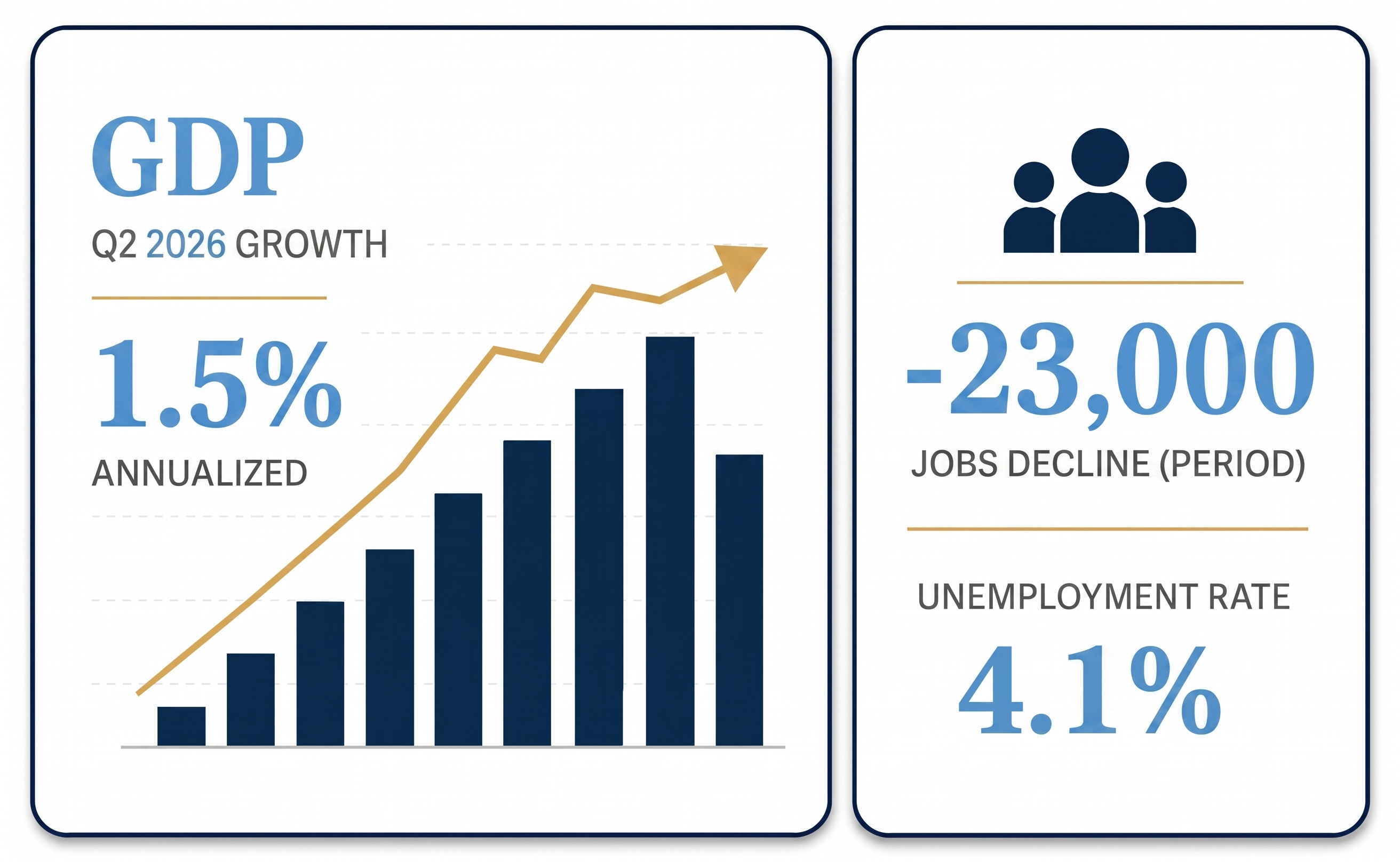
The July employment report appeared weak at first glance, with payrolls declining by 23,000 and prior months revised lower. However, temporary factors skewed the headline number. Local government education accounted for most of the decline because the survey timing captured an unusually large number of summer school contract expirations. The World Cup hiring spree also appears to have exaggerated weakness in retail and leisure employment. Despite the discouraging headline, more than half of all industries added jobs in July, including construction and information services. The unemployment rate fell to 4.2%, jobless claims remained low, and announced layoffs reached their lowest level in two years.
The greater constraint in the labor market may be the supply of workers. Baby Boomer retirements and slower immigration have reduced labor-force growth, allowing unemployment to remain low despite modest hiring. Worker shortages are also pushing wages higher in specialized areas tied to the artificial intelligence buildout. On balance, we believe the report will allow the Fed to hold rates steady as it seeks its dual mandate of full employment and price stability.
GDP: Underlying Growth Was Better Than the Headline
The U.S. economy grew by 1.5% during the second quarter, down from 2.1% in the previous quarter. While the headline suggests weaker growth, the report’s details show that private-sector demand remains intact. Consumer spending accelerated to a 3.2% rate, contributing more than two percentage points to economic growth. Business investment rose 8.4%, supported by continued spending on technology, equipment, software, and data-center infrastructure.
Imports, which are netted out of exports, reduced second-quarter GDP by a full 1%. Many of the imported products, including semiconductors, servers, electrical equipment, and cooling systems, are supporting the domestic AI investment boom.
The most concerning part of the report was inflation. Core PCE accelerated during the quarter to 3.4%, which may push the Fed to keep interest rates higher for longer. The economy appears to remain on relatively firm footing, but solid demand and continued strength in investment activity could make the Federal Reserve’s inflation fight more difficult.
Disclosures
CCM Investment Advisers, LLC is a Registered Investment Adviser registered with the U.S. Securities and Exchange Commission (CRD# 105743). Any type of investing involves risk of loss and there are no guarantees that the strategies described on this website or any of the associated literature may be successful. The opinions and information contained in this report are for informational purposes only and are not meant to be predictors of future results. Such opinions and information do not constitute an offer or solicitation to provide investment advisory services. Such an offer can only be made in states where CCM Investment Advisers is registered.
Any type of investing involves risk of loss and there are no guarantees that the strategies described may be successful. Any performance data report represents historical data and future returns may differ significantly. Past performance does not guarantee future results. CCM Investment Advisers does not assume liability for any loss which may result from the reliance by any person upon such information or opinions.
Security, index and economic information are obtained from resources which CCM believes to be accurate, but no warrant is made to the accuracy or completeness of the information. Various indices described and discussed herein are unmanaged; investments cannot be made directly into an index. Indices do not incur fees that reduce performance. The performance and volatility of an index or mix of indices will not be the same as a CCM client account.
The term federal funds rate refers to the target interest rate set by the Federal Open Market Committee (FOMC). This target is the rate at which commercial banks borrow and lend their excess reserves to each other overnight.
Labor Market Statistics are derived from nonfarm payroll statistics released monthly by the Bureau of Labor.
The Consumer Price Index (CPI) released monthly by the Bureau of Labor Statistics is a measure of the average change over time in the prices paid by urban consumers for a market basket of consumer goods and services.