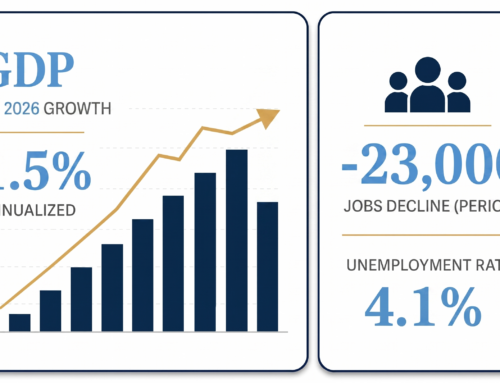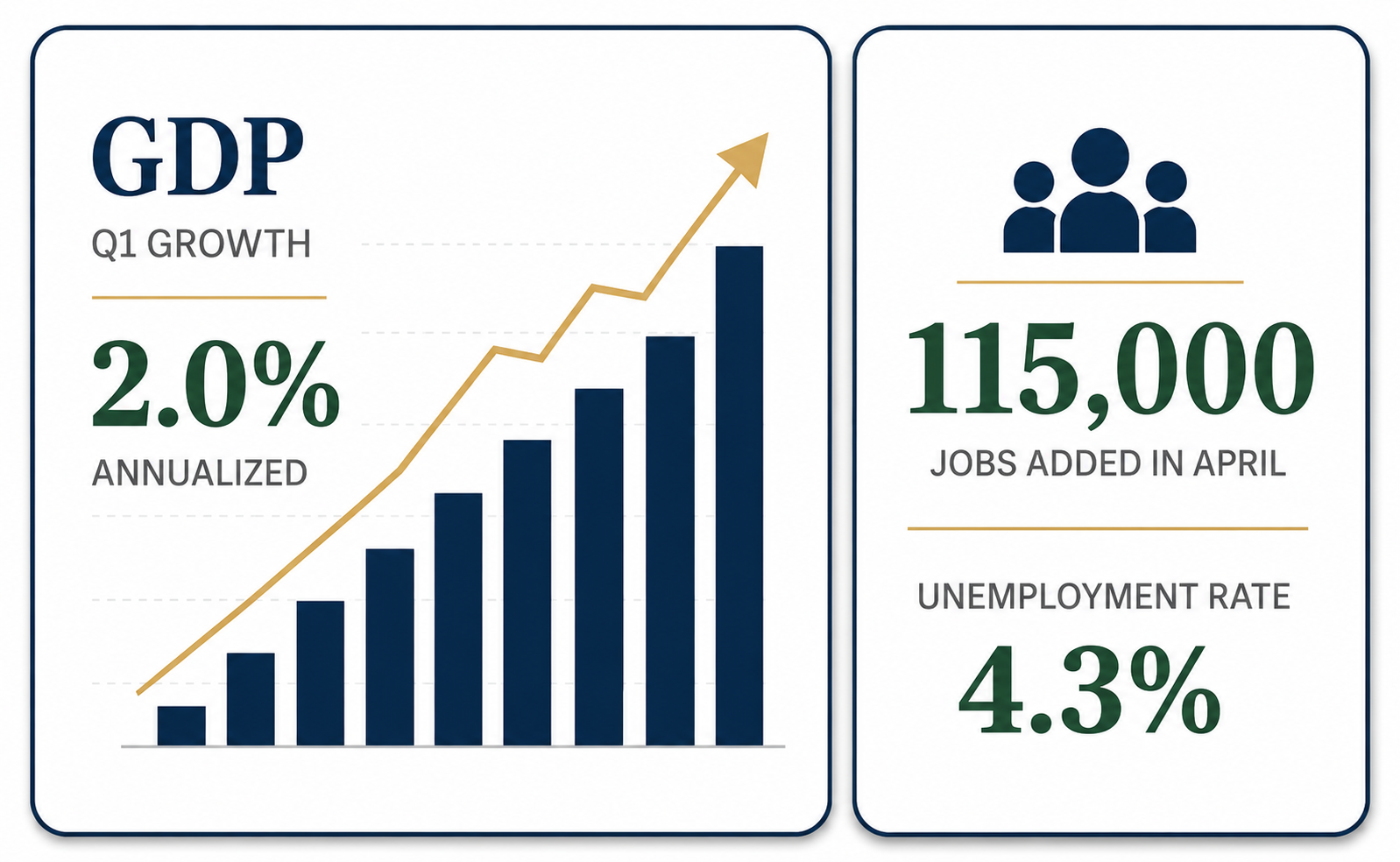
The latest economic data paints an encouraging picture. First-quarter GDP grew at a healthy 2.0% annualized rate. Consumer spending slowed from recent levels but still grew at over 1% for the quarter. Business investment continues to hold up well, particularly in technology, software, and AI-related equipment.
The labor market has been beating expectations over the past 2 months, a welcome reprieve from last year’s weakness. April added 115,000 jobs, and the prior month was revised upward to 185,000. The unemployment rate held steady at 4.3%, still low by historical standards, and job gains spread across a wider range of industries. Encouragingly, more economically sensitive sectors like logistics and hospitality contributed to hiring, suggesting that demand for workers isn’t confined to just a few corners of the economy.
Equally important, wage growth is cooling in a healthy way. Average hourly earnings rose 3.6% over the past year, and recent monthly gains have moderated. Labor cost growth also slowed meaningfully in the first quarter. This combination, steady hiring without renewed wage pressure, is a positive sign, as it reduces the risk that the labor market reignites inflation. The downside is that the recent spike in fuel prices will add strain to lower-income workers.
Some indicators look softer on the surface. Workforce participation has edged down, hiring is slower than in past cycles, and real take-home pay has been relatively flat. But much of this reflects demographics rather than distress. As Baby Boomers retire, higher-earning workers are stepping back, which naturally weighs on measured wage and income growth. Meanwhile, many retirees are drawing on accumulated savings, helping to sustain consumer spending even as wage growth moderates.
Bottom Line: The economy remains resilient, but not without risk. Elevated energy prices, tariff-related cost pressures, and sticky services inflation are worth watching. That said, the labor market currently sits in a favorable position, strong enough to support continued economic growth, but not so hot that it forces the Federal Reserve to tighten further.
Disclosures
CCM Investment Advisers, LLC is a Registered Investment Adviser registered with the U.S. Securities and Exchange Commission (CRD# 105743). Any type of investing involves risk of loss and there are no guarantees that the strategies described on this website or any of the associated literature may be successful. The opinions and information contained in this report are for informational purposes only and are not meant to be predictors of future results. Such opinions and information do not constitute an offer or solicitation to provide investment advisory services. Such an offer can only be made in states where CCM Investment Advisers is registered.
Any type of investing involves risk of loss and there are no guarantees that the strategies described may be successful. Any performance data report represents historical data and future returns may differ significantly. Past performance does not guarantee future results. CCM Investment Advisers does not assume liability for any loss which may result from the reliance by any person upon such information or opinions.
Security, index and economic information are obtained from resources which CCM believes to be accurate, but no warrant is made to the accuracy or completeness of the information. Various indices described and discussed herein are unmanaged; investments cannot be made directly into an index. Indices do not incur fees that reduce performance. The performance and volatility of an index or mix of indices will not be the same as a CCM client account.
The term federal funds rate refers to the target interest rate set by the Federal Open Market Committee (FOMC). This target is the rate at which commercial banks borrow and lend their excess reserves to each other overnight.
Labor Market Statistics are derived from nonfarm payroll statistics released monthly by the Bureau of Labor.
The Consumer Price Index (CPI) released monthly by the Bureau of Labor Statistics is a measure of the average change over time in the prices paid by urban consumers for a market basket of consumer goods and services.